Pantone Gold Color Codes, Shades & Conversions
This page covers the most important Pantone codes in the gold family — including metallic Pantone 871 C, 874 C, and process golds 123 C and 1235 C — with verified HEX, RGB, and CMYK equivalents. Explore luxury brand uses, metallic printing guidance, and free conversion tools.
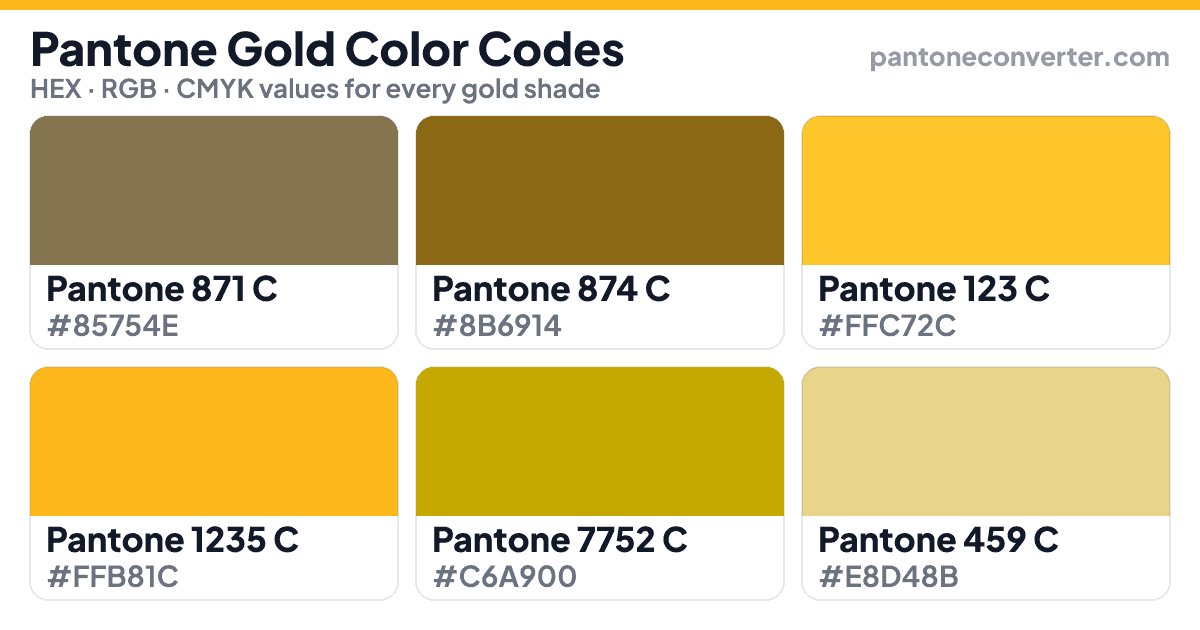
Primary Pantone Gold Codes
The six most widely used Pantone gold codes across luxury branding, packaging, print, and design — spanning metallic spot inks and process golds. Each includes verified HEX, RGB, and CMYK values.
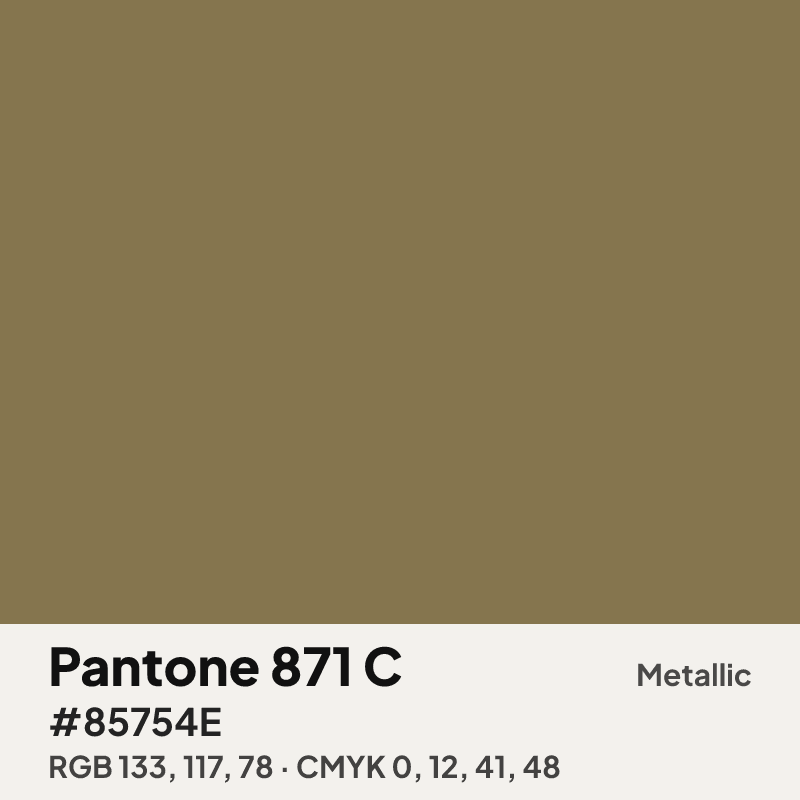 #85754E
#85754E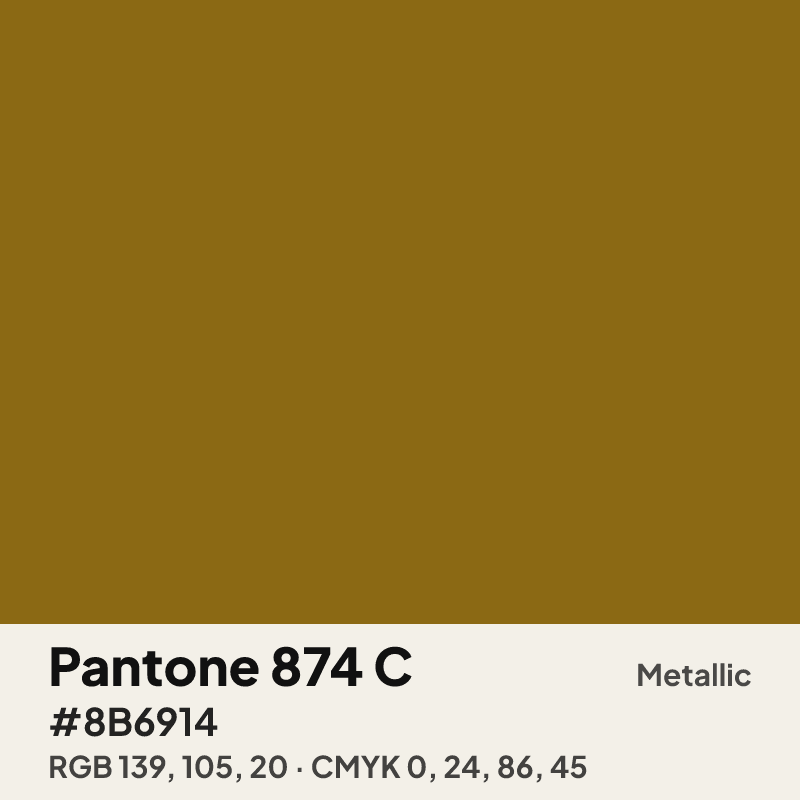 #8B6914
#8B6914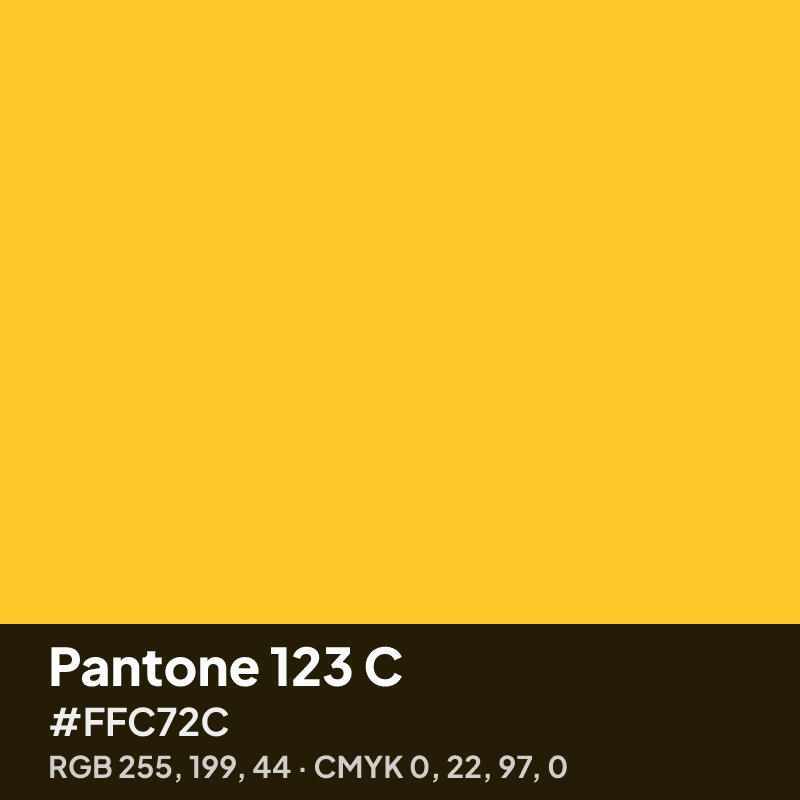 #FFC72C
#FFC72C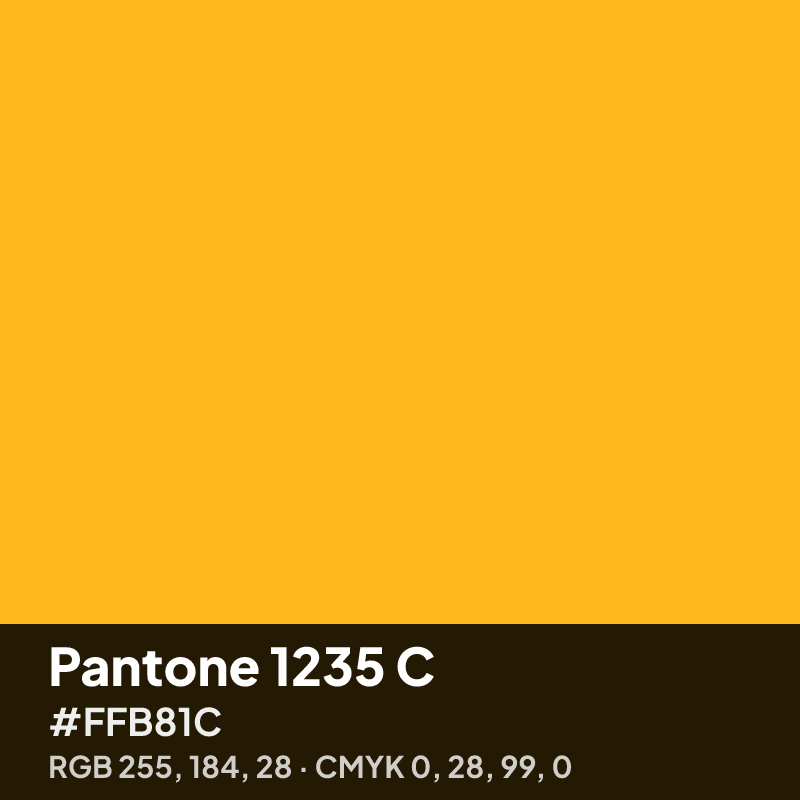 #FFB81C
#FFB81C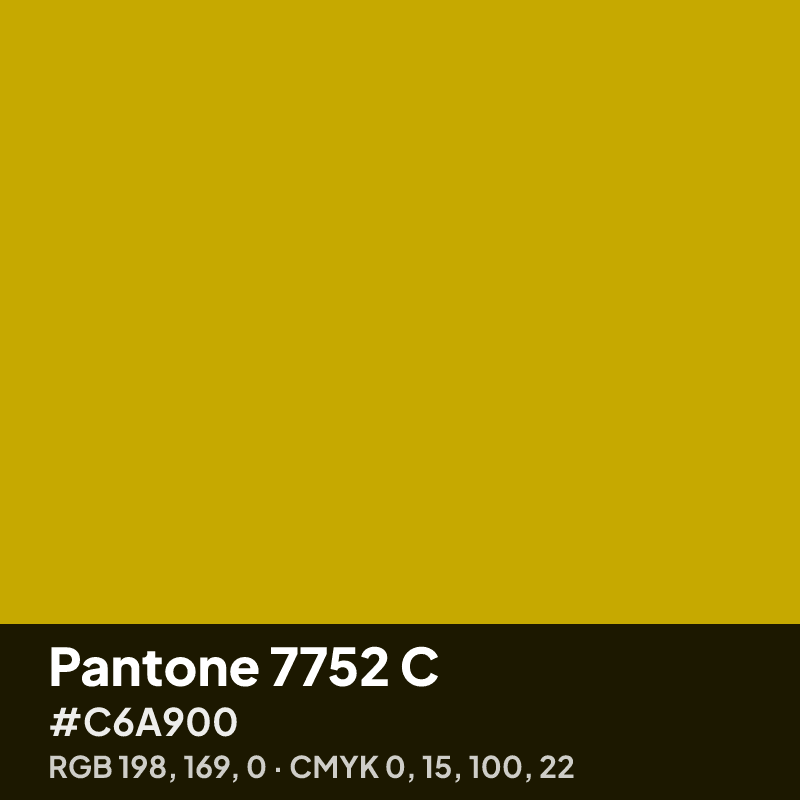 #C6A900
#C6A900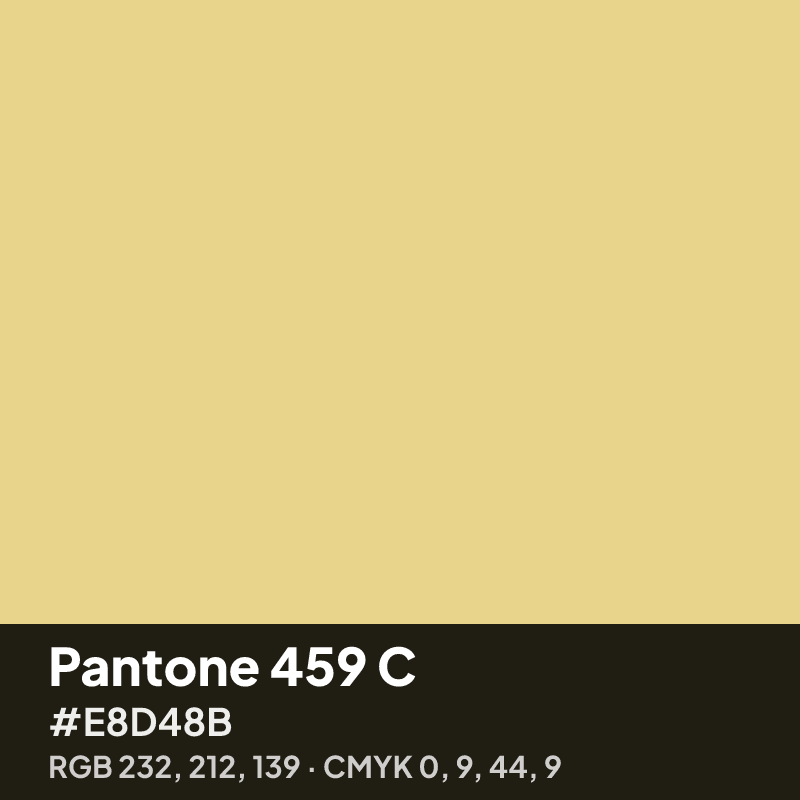 #E8D48B
#E8D48BGold Pantone Color Values — Complete Reference
Full color values for 8 Pantone gold codes — from light champagne golds to deep antique and metallic golds — covering both coated and metallic finishes.
| Pantone Code | Finish | HEX | RGB | CMYK | HSL | HSB |
|---|---|---|---|---|---|---|
Pantone 459 C | Coated | #E8D48B | 232, 212, 139 | 0, 9, 44, 9 | 43°, 64%, 73% | 43°, 40%, 91% |
Pantone 123 C | Coated | #FFC72C | 255, 199, 44 | 0, 22, 97, 0 | 43°, 100%, 59% | 43°, 83%, 100% |
Pantone 1235 C | Coated | #FFB81C | 255, 184, 28 | 0, 28, 99, 0 | 43°, 100%, 55% | 43°, 89%, 100% |
Pantone 7752 C | Coated | #C6A900 | 198, 169, 0 | 0, 15, 100, 22 | 51°, 100%, 39% | 51°, 100%, 78% |
Pantone 459 U | Uncoated | #DCC87A | 220, 200, 122 | 0, 9, 45, 14 | 44°, 58%, 67% | 44°, 45%, 86% |
Pantone 871 C | Coated (Metallic) | #85754E | 133, 117, 78 | 0, 12, 41, 48 | 42°, 26%, 41% | 42°, 41%, 52% |
Pantone 874 C | Coated (Metallic) | #8B6914 | 139, 105, 20 | 0, 24, 86, 45 | 43°, 75%, 31% | 43°, 86%, 55% |
Pantone 8641 C | Coated (Metallic) | #8C7B5E | 140, 123, 94 | 0, 12, 33, 45 | 37°, 20%, 46% | 37°, 33%, 55% |
Note: HEX values for metallic Pantone golds (871 C, 874 C, 8641 C) are approximations only — the true metallic sheen cannot be represented in digital color values. Always verify against a physical Pantone Metallic swatch book before production. Learn more about coated vs. uncoated Pantone differences.
Gold CMYK Codes for Print
Need gold in CMYK? These are the closest four-color process builds for the most-used Pantone golds. Process inks cannot reproduce a metallic sheen, so for 871 C, 874 C and 8641 C the CMYK values give a flat, non-metallic approximation of the colour — use a metallic spot ink when the shine matters.
| Pantone Code | CMYK | Finish | Best Use |
|---|---|---|---|
Pantone 123 C | 0, 22, 97, 0 | Coated | Bright, warm yellow-gold |
Pantone 1235 C | 0, 28, 99, 0 | Coated | Deeper orange-gold |
Pantone 7752 C | 0, 15, 100, 22 | Coated | Rich, flat "classic gold" |
Pantone 459 C | 0, 9, 44, 9 | Coated | Pale champagne gold |
Pantone 871 C | 0, 12, 41, 48 | Coated (Metallic) | CMYK fallback for metallic gold |
Pantone 874 C | 0, 24, 86, 45 | Coated (Metallic) | CMYK fallback for antique gold |
Pantone 8641 C | 0, 12, 33, 45 | Coated (Metallic) | CMYK fallback for muted metallic gold |
For the web-standard gold (#FFD700), the CMYK equivalent is 0, 16, 100, 0 — brighter than any printed Pantone gold. To match a specific gold of your own, use the CMYK to Pantone converter.
Convert a Gold Pantone Code
Use our free tools to convert any gold Pantone code to HEX, RGB, or CMYK — or find the closest Pantone match for a gold you already have.
What Does Gold Mean? Psychology & Symbolism
Gold communicates luxury, prestige, success, and wealth in a way that no other color can fully replicate. As a color, gold occupies a unique psychological space — it simultaneously references a precious metal, the warmth of sunlight, and the radiance of fire. In color psychology, gold consistently triggers associations with achievement, supreme value, and exclusivity. It is the color of first place, of royalty, of the divine. These associations are not culturally arbitrary — they are rooted in millennia of human experience in which gold has represented the rarest and most coveted of materials.
Gold is used almost universally in luxury branding precisely because it signals premium quality with an immediacy that words cannot match. Unlike yellow — which can feel cheap, cautionary, or even childish depending on context — gold has a weight, seriousness, and gravitas that commands respect. The difference is felt instinctively: a product with a gold Pantone foil stamp reads as definitively premium, while the same design in bright yellow reads as cheerful but ordinary. This is why a Pantone metallic gold like 871 C or 874 C — with its genuine reflective sheen — carries far more luxurious connotation than even the brightest process gold.
Culturally, gold is one of the most universally positive colors in human symbolism. In Western cultures, gold medals represent absolute first place and unsurpassed excellence — the Olympic gold medal is the apex achievement in sport. In Buddhism, gold is sacred and deeply spiritual, representing enlightenment, wisdom, and the divine nature of the Buddha; gold leaf adorns temples and statues throughout Southeast Asia. In African cultures, particularly in Ghana’s Ashanti tradition, gold represents royalty, divine connection, and kingly authority — the Golden Stool is the most sacred object in Ashanti culture. In Chinese tradition, gold is a color of good fortune, prosperity, and celebration, closely related to the imperial yellow of the ancient emperors.
In design practice, gold works most powerfully as an accent color against deep, rich backgrounds — navy, black, deep forest green, or deep burgundy — where it creates maximum contrast and a compelling sense of luxury. Metallic Pantone golds like 871 C and 874 C have a unique luminosity and depth that process (non-metallic) golds cannot replicate; under different lighting conditions, they shift and shimmer in ways that add a sense of life and premium craftsmanship to printed materials. Designers reaching for gold should consider whether the project warrants a true metallic specification — foil stamping, metallic ink, or embossing — rather than a CMYK approximation, because the difference in perceived quality is significant and immediately apparent to the end consumer.
Famous Brands That Use Gold Pantone Colors
Few brands have integrated gold into their identity as completely as Rolex (explore Rolex brand colors). Pantone 871 C and Pantone 874 C metallic golds are commonly associated with Rolex branding, packaging and watch dial references. The precise, restrained quality of Pantone 871 C — a classic, slightly muted metallic gold — suits understated luxury branding. The deeper, richer warmth of Pantone 874 C is commonly associated with Rolex’s yellow gold, and in print it reads closer to polished precious metal. For any luxury brand, choosing the right metallic Pantone is more than a design decision: it shapes how the quality of the product is perceived.
Chanel (explore Chanel brand colors) uses gold extensively across their iconic interlocking CC logo, perfume bottles, and packaging — the black-and-gold visual language of Chanel is one of the most recognized brand identities in the world. In print materials and packaging, Chanel references Pantone 123 C and Pantone 1235 C as their process gold standards, with metallic foil stamps and embossing adding the premium physical dimension. The combination of matte black and Pantone gold creates an unmistakable luxury signal that has remained consistent across decades of brand evolution.
Louis Vuitton (explore Louis Vuitton brand colors) uses a distinctive warm gold — closely aligned with Pantone 1235 C — across their monogram hardware, packaging, and brand communications. The LV monogram hardware, which appears on bags, luggage, and accessories, is specified to a warm golden tone that must maintain consistency across metal castings, foil printing, and digital brand assets. The warm amber quality of Pantone 1235 C suits Louis Vuitton’s heritage aesthetic perfectly: it reads as genuinely golden without being brash, evoking craftsmanship, tradition, and the patina of fine materials that age beautifully over time.
Gold Pantone Shades — From Light to Dark
The gold family in the Pantone system spans from Pantone 9284 C (a barely-there champagne gold) through vivid process golds to deep antique and metallic golds like Pantone 871 C and 874 C. Lighter tints communicate softness and delicacy, while deep golds signal authority and heritage.
Gold Pantone: Coated (C) vs. Uncoated (U) & Metallic
Gold Pantone colors are among the most substrate-sensitive in the entire Pantone Matching System — and the difference between finishes is particularly dramatic for metallics. Metallic Pantone golds such as Pantone 871 C and 874 C are specifically formulated for coated stocks, where their metallic pigment particles can sit on the surface and reflect light effectively, producing the genuine shimmering sheen that makes them so valuable in luxury applications. On coated (C) stock — whether gloss, silk, or matte-coated — these metallics perform at their intended specification.
On uncoated (U) paper, metallic Pantone golds lose much of their luster and can appear flat, dull, and brownish — a significant departure from their intended effect. The ink absorbs into the uncoated paper’s fibers rather than sitting on the surface, which eliminates the reflective quality entirely. If your project requires uncoated stock and a gold effect, consider using a process gold like Pantone 123 U or 1235 U (the uncoated variants), and accept that the result will be a warm yellow-gold tone rather than a metallic one. Alternatively, explore foil stamping on uncoated stock for a metallic effect without relying on metallic ink.
For textile applications — garments, soft goods, upholstery — gold Pantone colors are referenced using the Pantone TPG (Textile, Paper, Garment) system. The TPG equivalents for gold shades provide standardized references that fabric dyers and embroidery thread manufacturers can match. If you are producing garments or soft furnishings with gold accents, always request TPG variants from your supplier rather than using the Pantone C or U codes directly, as the coated/uncoated system does not translate to textile substrates. Learn more about coated vs. uncoated Pantone differences.
How Gold Pantone Is Used Across Industries
Print & Packaging
Metallic gold inks dominate the luxury print and packaging sector. Spirits brands — champagne, whisky, cognac — use Pantone metallic gold foils and spot inks on labels and gift boxes to signal premium quality at point of sale. Chocolate and confectionery brands use gold foil packaging to position products in the premium gift tier. Award certificates, trophies, and recognition materials almost universally use Pantone 871 C as the gold standard. Pantone metallic golds are also used extensively in wedding and event stationery, where gold embossing and foiling on invitation suites communicate celebration and prestige.
Fashion & Apparel
Gold accessories and hardware are a perennial fixture in luxury fashion. Handbag clasps, belt buckles, chain straps, and shoe embellishments are specified to gold Pantone standards — typically Pantone 874 C for a rich yellow gold or Pantone 8641 C for a slightly more understated warm gold. Fashion houses use Pantone gold references to maintain consistency between seasons across different suppliers and manufacturing countries. In embroidery and thread applications, TPG gold variants are used for garment decoration. The Pantone Fashion Color Trend Reports regularly feature gold-adjacent shades — from bright process golds to deep antique golds — across seasonal palettes.
Interior Design
Gold accents in light fixtures, hardware, fittings, and decorative elements are a defining feature of luxury interior design. Interior designers reference Pantone gold codes when specifying finishes for door handles, faucets, lamp bases, picture frames, and decorative accessories, ensuring that metallic finishes across different suppliers maintain visual harmony. Pantone 871 C and 874 C serve as the primary references for yellow gold hardware finishes. In wall coverings and fabric selections, process gold tones like Pantone 459 C (champagne gold) and Pantone 7752 C (antique gold) guide fabric dyers, wallpaper manufacturers, and paint formulators. Gold accents in interiors are most effective when balanced against deep, rich backgrounds.
Digital & Branding
In digital brand design, gold gradients, metallic effects, and gold typography are used extensively for premium brand experiences — subscription upgrades, loyalty program materials, award badges, and premium tier interfaces. Since true metallic gold cannot be rendered on screen, digital designers use the HEX approximations of Pantone gold codes as their reference — Pantone 1235 C (#FFB81C) and Pantone 123 C (#FFC72C) are the most common process gold references for digital use. Gold gradient effects are frequently created by combining a lighter gold (such as #FFC72C) with a deeper amber (such as #A88900) to simulate a metallic sheen in digital environments. Brand identity systems that span print and digital must carefully document both the Pantone code (for print) and the equivalent HEX (for digital) to maintain cross-media consistency.
Explore Related Pantone Color Families
Pantone Gold in Other Colour Systems
A Pantone number only helps if your supplier works in Pantone. If this gold is heading for paint, thread, vinyl or fabric, these converters find the nearest code in the system that supplier actually uses — each one reporting how close the colour match really is.
Tolerance matters more than the code itself: a ΔE00 under 2 is generally accepted as a commercial colour match, while anything past 5 is obvious side by side. Every converter above reports that distance, so you can judge a substitute before it reaches a production run.
Frequently Asked Questions About Gold Pantone
What is the Pantone code for metallic gold?+
The most widely used Pantone codes for metallic gold are Pantone 871 C and Pantone 874 C. These are true metallic inks within the Pantone Metallic Colors system and produce a genuine reflective sheen that process (CMYK) printing cannot replicate. Pantone 871 C is the classic, slightly muted metallic gold used on certificates, awards, and luxury packaging. Pantone 874 C is a richer, warmer metallic gold frequently associated with jewelry and watchmaking brands such as Rolex. For non-metallic bright gold effects in process printing, Pantone 123 C and Pantone 1235 C are the standard choices.
What is the difference between Pantone 871 C and Pantone 874 C?+
Both Pantone 871 C and Pantone 874 C are metallic gold inks in the Pantone Metallic system, but they differ in tone and depth. Pantone 871 C (HEX approximation #85754E) is a classic, slightly cool-toned metallic gold — restrained and elegant, suitable for certificates, official seals, and heritage packaging. Pantone 874 C (HEX approximation #8B6914) is a deeper, warmer, and richer metallic gold with more amber in its tone. It has a more pronounced golden depth and is strongly associated with luxury goods including watchmakers, jewelers, and high-end cosmetics. When choosing between the two, consider whether you need a classic understated gold (871 C) or a bolder, warmer statement gold (874 C).
What Pantone gold is used by luxury brands?+
Different luxury brands use different Pantone golds depending on their identity. Pantone 871 C and 874 C metallic golds are commonly associated with Rolex branding. Chanel uses Pantone 123 C and 1235 C for print materials accompanying their iconic CC logo and packaging. Louis Vuitton uses a warm gold aligned with Pantone 1235 C across their monogram hardware and packaging. For award ceremonies and trophy design, Pantone 871 C is the industry standard. In the jewelry sector, Pantone 874 C is the preferred metallic reference for yellow gold. Always verify the exact PMS code with your supplier, as some luxury brands use proprietary or custom-mixed metallic formulations.
How do I print metallic gold Pantone?+
Printing metallic gold Pantone colors requires the use of Pantone Metallic spot inks — these are pre-mixed inks that contain actual metallic pigment particles (typically aluminum or bronze) that create a reflective, shimmering effect. Pantone 871 C and 874 C cannot be reproduced through standard CMYK four-color printing. You must specify a spot color run in addition to (or instead of) CMYK. Most commercial offset printers can add a Pantone metallic pass as a 5th or 6th color. For digital printing, metallic effects are generally not achievable — you would need to substitute a process gold such as Pantone 123 C or use a foiling technique. Always proof metallic gold inks on your actual substrate before final production, as the metallic effect varies significantly between coated and uncoated stocks.
What industries use gold Pantone colors?+
Gold Pantone colors are used across a wide range of premium and luxury industries. In luxury goods and fashion, brands like Rolex, Chanel, and Louis Vuitton specify metallic Pantone golds for packaging, hardware references, and print materials. In print and publishing, gold is used on book covers, award certificates, invitations, and special edition packaging — often using Pantone 871 C or 873 C as metallic spot colors. In the food and beverage sector, gold is used extensively on premium chocolate, champagne, and spirits packaging to signal quality and indulgence. In interior design, gold Pantone references guide the selection of hardware finishes, lighting fixtures, and accent materials. In digital design, process golds like 123 C and 1235 C are used in gradients and premium brand interfaces.
Can I convert a gold Pantone to CMYK?+
You can convert process (non-metallic) gold Pantone codes like Pantone 123 C (CMYK: 0, 22, 97, 0) and Pantone 1235 C (CMYK: 0, 28, 99, 0) to CMYK with reasonable accuracy — these are standard spot colors that have established CMYK equivalents. However, metallic Pantone golds such as Pantone 871 C and 874 C cannot be faithfully converted to CMYK because their defining characteristic — the metallic reflective sheen — is a physical property of the metallic ink particles, not a color value. A CMYK approximation of 871 C will look like a dull, flat olive-brown rather than a genuine metallic gold. If you must substitute a metallic gold with a CMYK equivalent, use Pantone 123 C or 1235 C and accept that the metallic quality will be lost. Use our free Pantone to CMYK converter at pantoneconverter.com/pantone-to-cmyk/ for instant CMYK breakdowns.