Pantone Orange Color Codes, Shades & Conversions
Discover the full range of Pantone orange codes, from vivid signal orange to earthy burnt tones. Find approximate HEX, RGB, and CMYK values, see real-world brand applications, and use our free color matching tools.
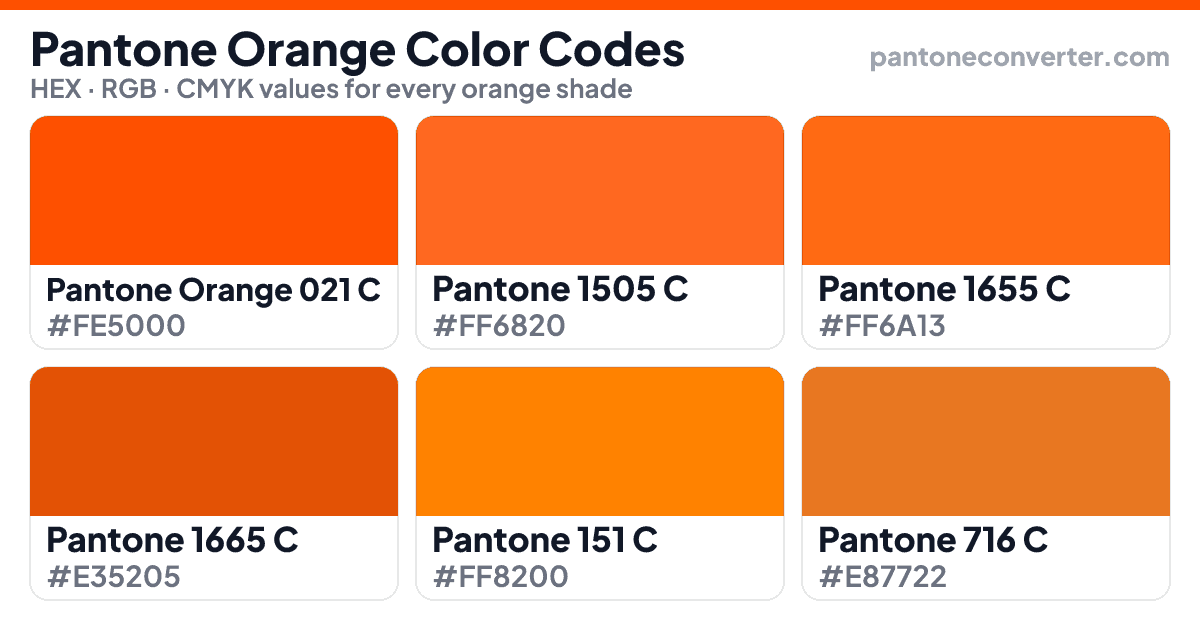
Primary Pantone Orange Codes
The six most recognizable Pantone orange codes used in global branding, from high-visibility safety orange to warm golden tones.
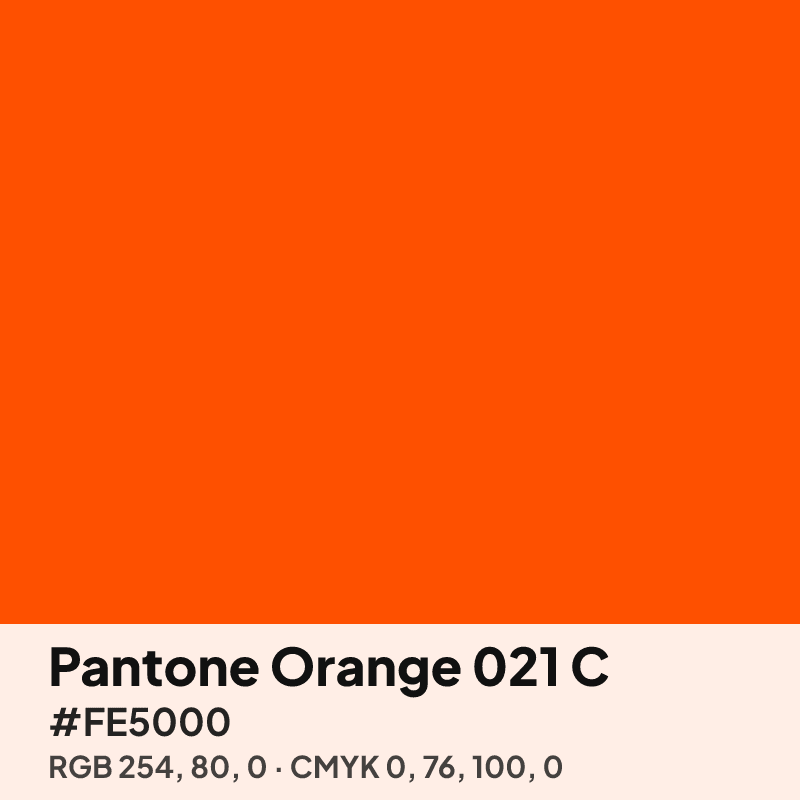 #FE5000
#FE5000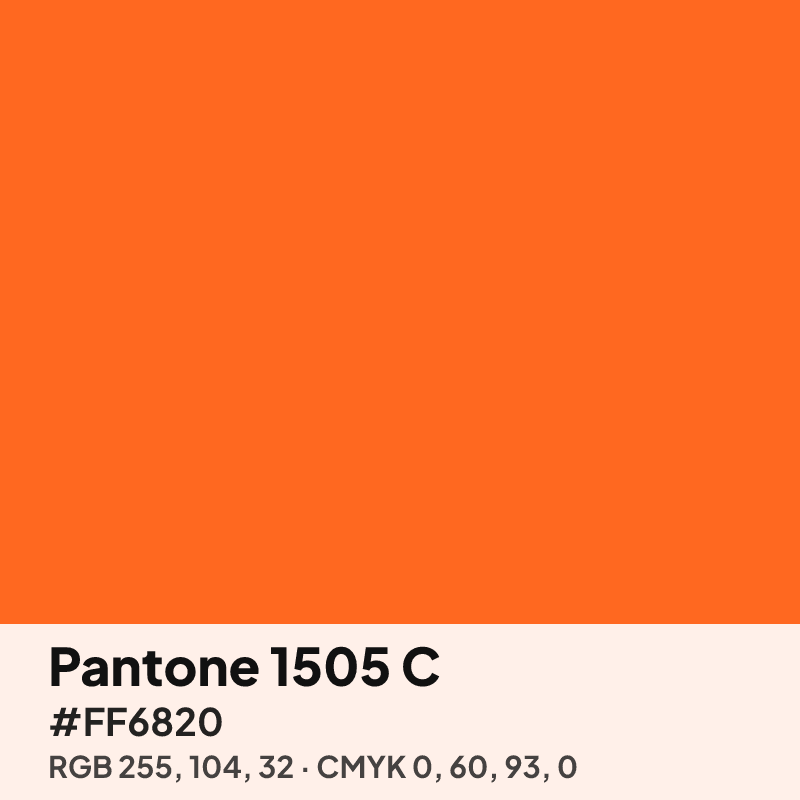 #FF6820
#FF6820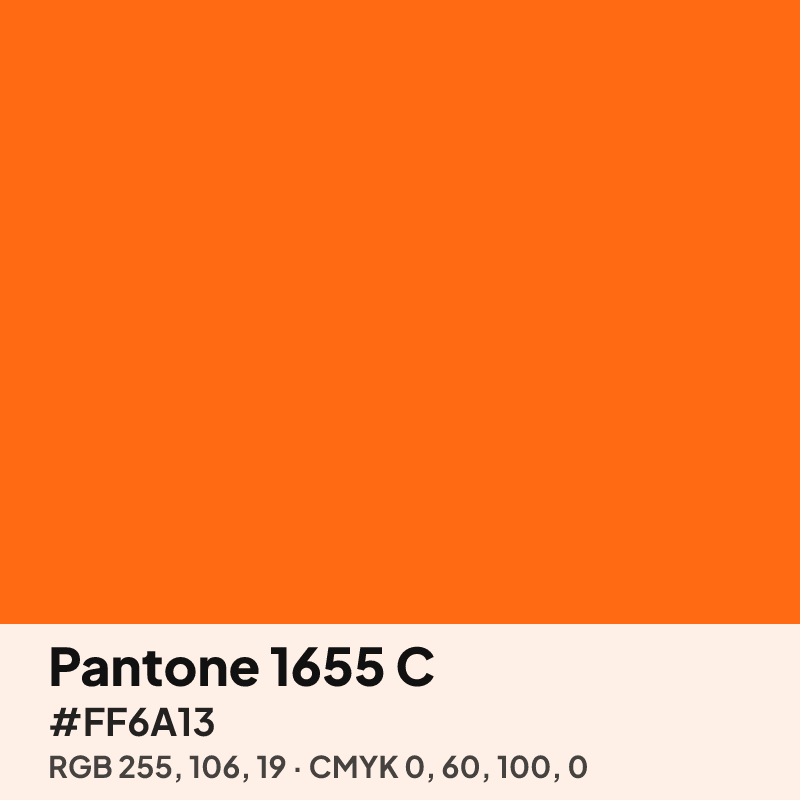 #FF6A13
#FF6A13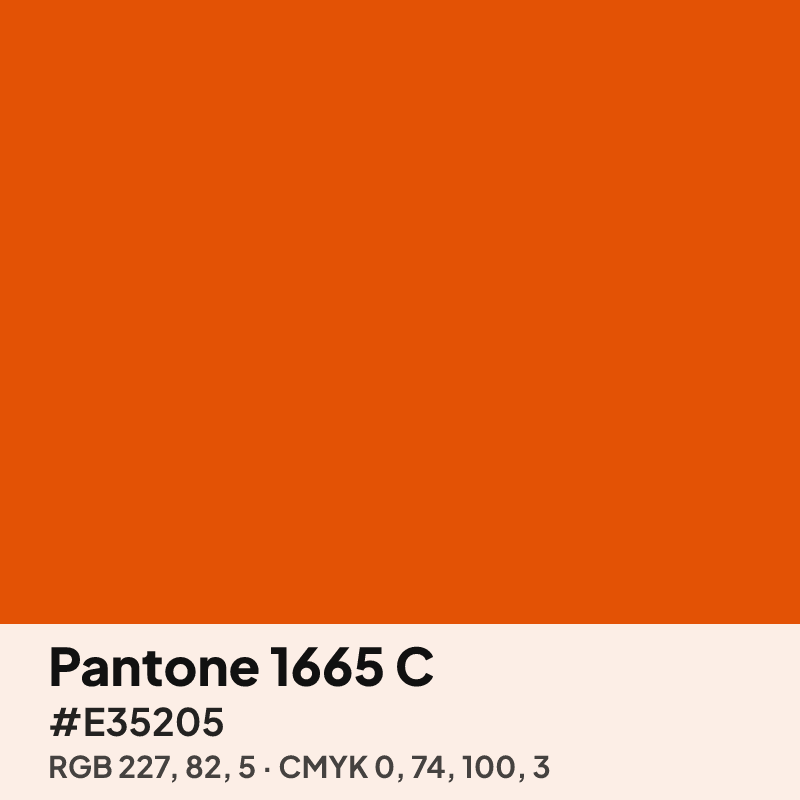 #E35205
#E35205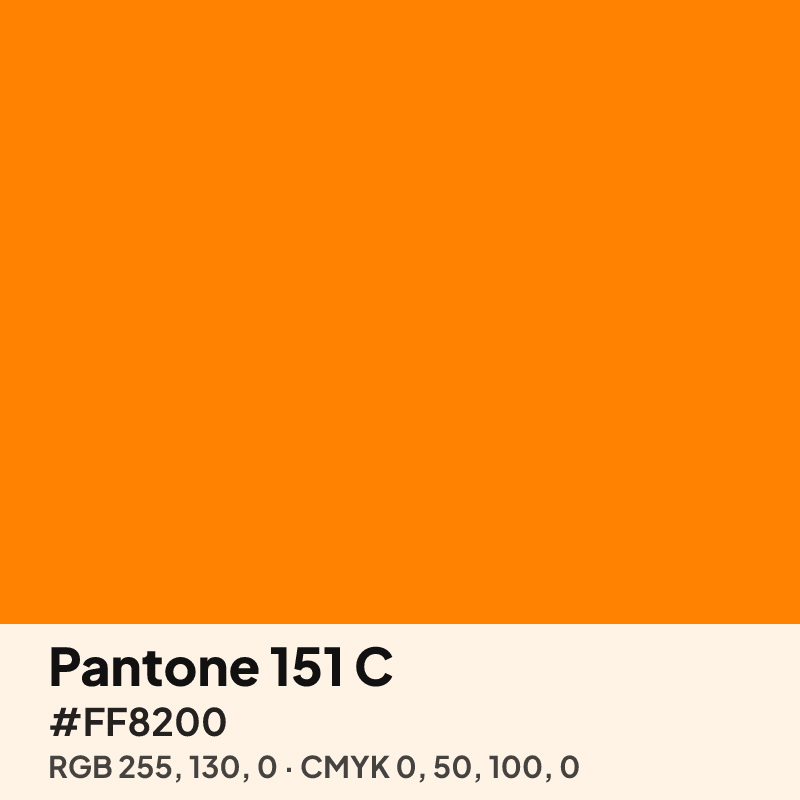 #FF8200
#FF8200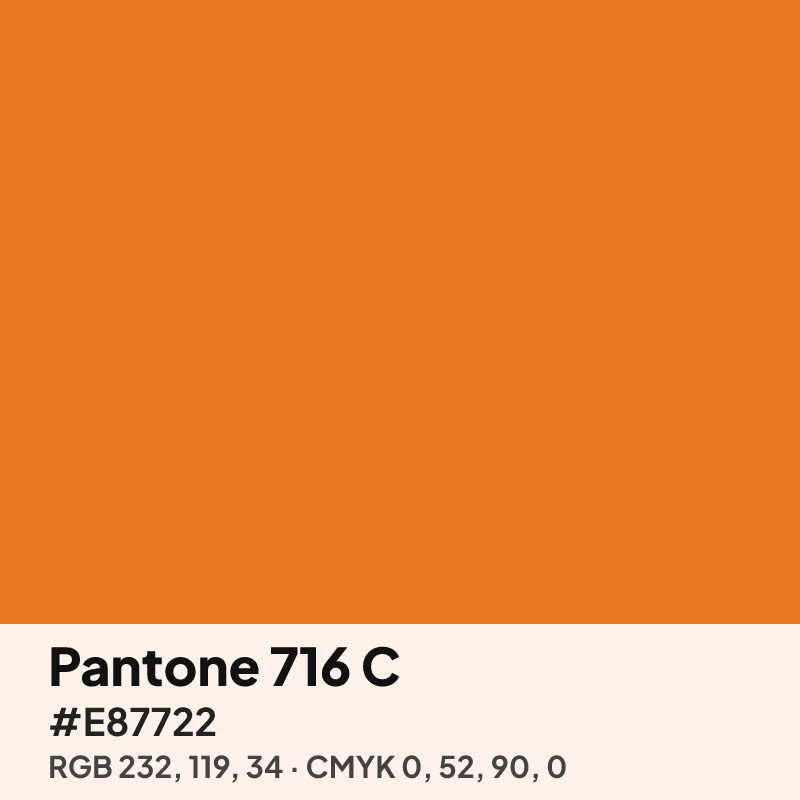 #E87722
#E87722Orange Pantone Color Values — Complete Reference
Full color values for 8 Pantone orange variants, including detailed HSL and HSB specifications for digital designers.
| Pantone Code | Finish | HEX | RGB | CMYK | HSL | HSB |
|---|---|---|---|---|---|---|
Pantone 1495 C | Coated | #FFB347 | 255, 179, 71 | 0, 30, 72, 0 | 35°, 100%, 64% | 35°, 72%, 100% |
Pantone 151 C | Coated | #FF8200 | 255, 130, 0 | 0, 50, 100, 0 | 31°, 100%, 50% | 31°, 100%, 100% |
Pantone 716 C | Coated | #E87722 | 232, 119, 34 | 0, 52, 90, 0 | 30°, 79%, 52% | 30°, 85%, 91% |
Pantone 1505 C | Coated | #FF6820 | 255, 104, 32 | 0, 60, 93, 0 | 21°, 100%, 56% | 21°, 87%, 100% |
Pantone 1655 C | Coated | #FF6A13 | 255, 106, 19 | 0, 60, 100, 0 | 22°, 100%, 54% | 22°, 93%, 100% |
Pantone Orange 021 C | Coated | #FE5000 | 254, 80, 0 | 0, 76, 100, 0 | 19°, 100%, 50% | 19°, 100%, 100% |
Pantone 1665 C | Coated | #E35205 | 227, 82, 5 | 0, 74, 100, 3 | 19°, 95%, 45% | 19°, 98%, 89% |
Pantone 166 C | Coated | #C8491A | 200, 73, 26 | 0, 69, 93, 17 | 17°, 77%, 44% | 17°, 87%, 78% |
Note: Screen rendering of vivid orange (RGB) often differs slightly from print output (CMYK). Always request a physical proof. Learn more about coated vs. uncoated Pantone differences.
Convert an Orange Pantone Code
Use our tools to accurately convert orange Pantone codes to HEX, RGB, or CMYK — or reverse match your custom orange to a Pantone standard.
What Does Orange Mean? Psychology & Symbolism
Orange occupies a unique position in color psychology as the combination of red’s energy and yellow’s warmth. It is the color of enthusiasm, creativity, adventure, and social interaction. Unlike red, which can feel aggressive or urgent, orange maintains an approachable energy that feels playful, confident, and inviting. Orange is one of the most visible colors in the natural world — think autumn leaves, sunsets, and tropical fruits — which contributes to its associations with harvest, abundance, and warmth.
In marketing psychology, orange combines the appetite-stimulating qualities of red with the optimism of yellow, making it highly effective in food and beverage contexts. It also communicates value and affordability when used in retail settings, which is why many budget-oriented or accessible brands use orange to signal deals, discounts, and friendliness. It removes the intimidation factor from shopping.
Culturally, orange has different resonances: in Western cultures it is associated with Halloween, autumn, and both creativity and caution (due to high-visibility gear); in Hinduism, orange (specifically saffron) is sacred and worn by monks; in the Netherlands, orange is a national color tied to the royal House of Orange and worn proudly during national events; in Ireland, orange has political significance as part of the flag’s three colors representing the Protestant tradition.
Different shades of orange communicate distinct personalities: vivid oranges like Pantone Orange 021 C feel bold, loud, and direct; amber-oranges like Pantone 716 C feel warm, premium, and reliable; burnt oranges like Pantone 1665 C feel earthy, seasonal, and artisanal. Brands leverage these specific shades to dial in exactly the right amount of energy.
Famous Brands That Use Orange Pantone Colors
Amazon uses a golden-orange hue, closely aligned with Pantone 716 C, as its signature accent color. This orange appears most famously in the logo’s swoosh/arrow, which points from ‘A’ to ‘Z’ while also forming a subtle smile. The warm, golden-orange communicates optimism, friendliness, and the delight of receiving a delivery — balancing the cool, corporate reliability of their primary dark text.
Fanta relies on a vivid, high-energy orange (similar to Pantone Orange 021 C and 1505 C) to communicate refreshment, fruit flavor, and youthful exuberance. Their use of this specific Pantone range ensures that the product feels energetic and highly visible on crowded supermarket shelves globally.
Harley-Davidson uses a bright amber-orange (Pantone 151 C) as a key brand color alongside their signature black. This specific orange represents the warmth of the open road, the heat of the engine, and classic American manufacturing heritage. It provides the perfect high-visibility contrast to their dark, rugged branding elements.
Orange Pantone Shades — From Light to Dark
The orange family transitions seamlessly from soft peach and apricot tones to intense neon oranges, and down into deep terracotta and rust shades.
Orange Pantone: Coated (C) vs. Uncoated (U)
Orange Pantone colors exhibit a significant shift in appearance depending on the paper stock they are printed on. On coated (C) stock — which is glossy or satin-finished — orange inks achieve maximum vibrancy, punch, and saturation. A color like Pantone Orange 021 C will look practically electric, leaping off the page. This is the desired effect for high-impact packaging and marketing collateral.
On uncoated (U) stock — such as standard matte paper or textured stationery — the porous nature of the paper absorbs the orange ink. This diminishes the color’s luminosity, often causing bright oranges to shift toward a warmer, more muted terracotta or dusty apricot tone. The high-energy impact is softened considerably.
Because of this dramatic variance, designers must always proof their orange colors carefully. If your brand relies on a highly saturated orange, you may struggle to achieve the same visual impact on uncoated business cards or natural-finish packaging. Learn more about coated vs. uncoated Pantone differences.
How Orange Pantone Is Used Across Industries
Print & Packaging
Orange is heavily utilized in high-visibility warning labels, safety manuals, and industrial packaging where immediate attention is required. Conversely, it is also a dominant color in food packaging, particularly for snacks and citrus-flavored beverages, because it naturally evokes warmth, freshness, and appetite stimulation.
Fashion & Apparel
In fashion, orange is a seasonal staple, strongly associated with autumn collections where burnt oranges and terracotta tones dominate. However, bright neon oranges also feature prominently in activewear, athletic shoes, and streetwear to convey high energy and motion.
Interior Design
Interior designers use deep, earthy oranges (like terracotta, rust, and clay) to create warm, inviting, and grounded spaces. Brighter oranges are occasionally used as accent colors in creative agency offices or dynamic startup environments to foster energy and collaborative thinking.
Digital & Branding
In UI/UX design, orange is a highly effective color for Call-To-Action (CTA) buttons, providing excellent contrast against white or dark backgrounds without the negative or warning connotations often associated with red. Brands seeking an approachable, friendly, or value-driven identity often adopt orange as a primary brand color.
Explore Related Pantone Color Families
Pantone Orange in Other Colour Systems
A Pantone number only helps if your supplier works in Pantone. If this orange is heading for paint, thread, vinyl or fabric, these converters find the nearest code in the system that supplier actually uses — each one reporting how close the colour match really is.
Tolerance matters more than the code itself: a ΔE00 under 2 is generally accepted as a commercial colour match, while anything past 5 is obvious side by side. Every converter above reports that distance, so you can judge a substitute before it reaches a production run.
Frequently Asked Questions About Orange Pantone
What is the Pantone code for orange?+
The foundational Pantone orange is Pantone Orange 021 C, a vivid and intense orange commonly used as a baseline standard for safety and bold packaging. Other popular variations include Pantone 151 C for amber-orange and Pantone 1655 C for sports branding.
What Pantone orange does Amazon use?+
Amazon uses Pantone 716 C, a warm, golden-orange hue, for its iconic swoosh/arrow in its logo. This color conveys optimism and friendliness.
What is Pantone Orange 021 C used for?+
Pantone Orange 021 C is heavily used in safety equipment, hazard signage, high-visibility clothing, and bold product packaging because it immediately commands attention and is one of the most visible colors in daylight.
How do I convert an orange HEX to Pantone?+
Use our free HEX to Pantone converter at pantoneconverter.com/hex-to-pantone/ — paste your HEX value and the tool will instantly find the nearest Pantone match across 3,100+ coated and uncoated swatches.
What industries use orange Pantone colors?+
Orange is widely used in food packaging to stimulate appetite, in safety equipment for visibility, in sports and fitness branding to convey energy, and in budget retail branding to communicate approachability and affordability.
Is Pantone orange different on coated vs. uncoated paper?+
Yes, orange is highly sensitive to the paper substrate. On coated (glossy) paper, orange appears incredibly vibrant and punchy. On uncoated (matte) paper, it tends to absorb into the fibers, losing saturation and appearing as a softer, more terracotta or muted tone.